
Introduction to the Open Letter
This blog post publishes an open letter I sent on Sunday, December 14 to members of the Danish Parliament, party leaders at Christiansborg, political youth organizations, selected civil society actors, and a broad range of Danish media outlets. The letter addresses a single, fundamental issue: the widening gap between democratic ideals of transparency and the persistent political and media silence surrounding Unidentified Anomalous Phenomena (UAP) and the question of extraterrestrial contact and disclosure. At the time of publishing this post, I have not received a response from a single political party, youth organization, or media institution to whom the letter was sent. In light of the subject matter and the dynamics described in the letter itself, this silence is, regrettably, unsurprising.
Before reading the letter, I invite you as a reader to pause and reflect on your own role within a democratic society. Democracy is not sustained by elected officials or journalists alone; it depends on citizens who are willing to engage critically, ask difficult questions, and insist on openness even when doing so carries social cost. When certain topics are systematically avoided, trivialized, or rendered invisible rather than openly examined, democracy erodes quietly—not through repression, but through acquiescence. As you read the letter below, consider not only whether you agree or disagree with its arguments, but what responsibility each of us carries when silence becomes the dominant response to questions that concern reality, truth, and our shared future.

An Open Letter to Danish Party Leaders and Members of the Folketing regarding openness and UAP-Disclosures.
Dear Members of the Danish Parliament, party leaders, and elected representatives, I hope this letter finds you well.
I Am writing this letter publicly and deliberately, as a citizen of a democratic society that prides itself on enlightenment, trust, and openness, yet increasingly avoids one of the most consequential questions of our time. The question is not whether unidentified anomalous phenomena exist — this has long since moved beyond speculation — but whether our political institutions are willing to acknowledge reality, engage with it openly, and respect the public’s right to truth. What I ask of you is therefore not belief, but honesty. What is your political position regarding extraterrestrial presence, contact, and disclosure — and why has this position not been stated openly to the Danish public?
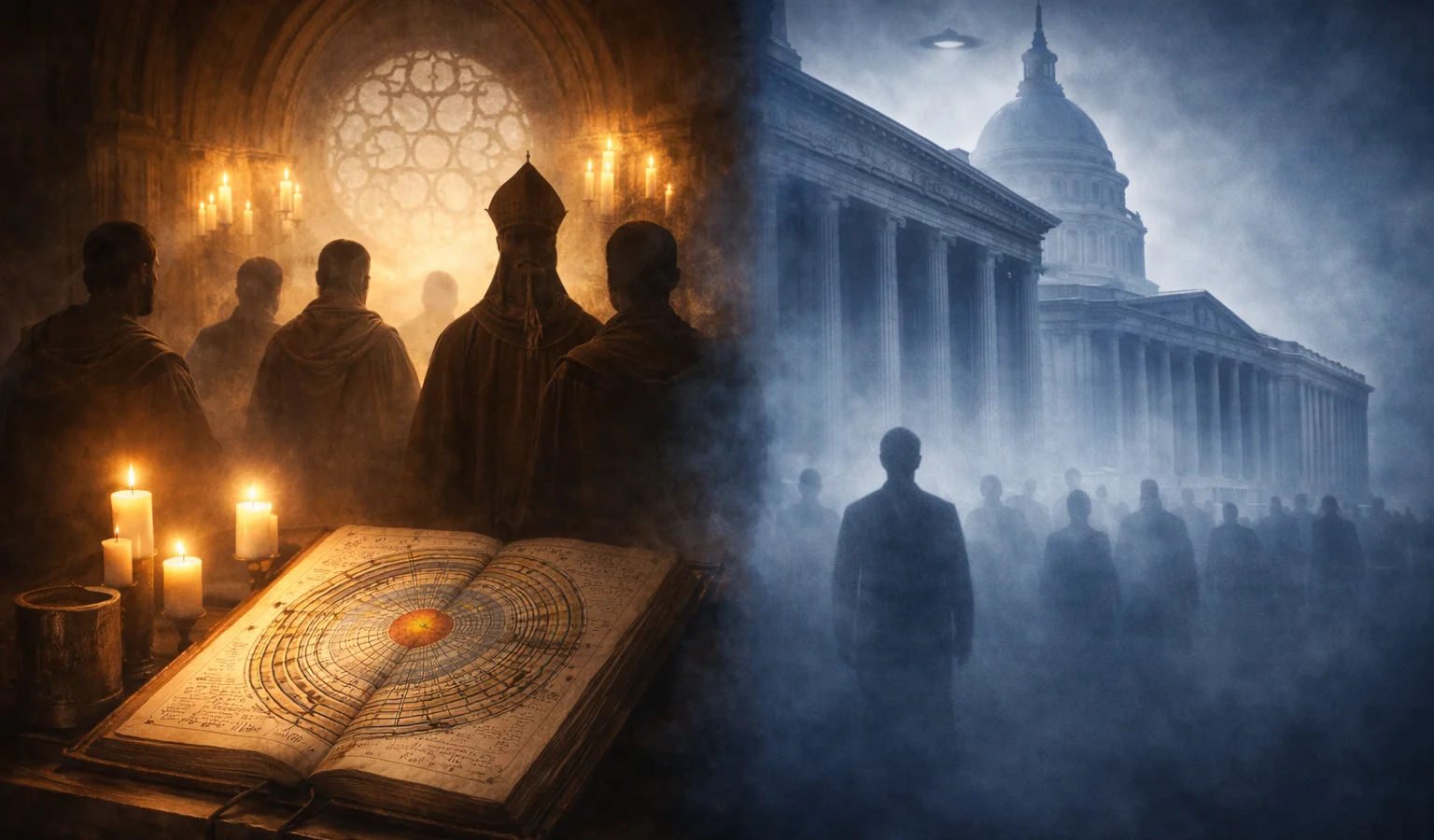
History teaches us something essential and uncomfortable: that power has rarely resisted the temptation to withhold truth when truth threatens established authority. In the Middle Ages, the Church did not merely dispute heliocentrism as a scientific hypothesis; it suppressed it as a threat to its ontological monopoly over reality itself. The insistence that the Earth was the center of creation was not just theology — it was control. Those who challenged this worldview were not answered with evidence, but with ridicule, silencing, excommunication, and violence. The tragedy is not that the Church was wrong, but that it believed humanity could not handle the truth. And yet, history proved the opposite. Society did not collapse when the Earth was no longer the center of the universe. On the contrary, the Enlightenment, science, medicine, and democracy itself became possible precisely because a shared ontological realism — a common understanding of what reality actually is — replaced dogma and secrecy.
A functioning democracy depends on such a shared ontological foundation. Citizens must inhabit the same basic reality as their institutions. When that shared reality fractures, trust collapses. Today, we are facing a parallel moment. The growing body of evidence, testimony, documentation, and official acknowledgment makes it increasingly clear that humanity is not alone in the universe and that contact with non-human intelligence has occurred and continues to occur. This is no longer a fringe claim. It is supported by decades of military encounters, radar data, sensor recordings, whistleblower testimony, and admissions from intelligence and defense officials. The French COMETA report concluded as early as 1999 that the extraterrestrial hypothesis was the most plausible explanation for certain phenomena. In the United States, this reality has been further corroborated by sworn testimony before Congress, by whistleblowers describing recovered non-human craft, by pilots recounting encounters with technology far beyond human capabilities, and by legislators openly stating that evidence is being withheld from both Congress and the public.
The recent interview ( https://www.youtube.com/watch?
George Knapp and Jeremy Corbell with U.S. Congress members Anna Paulina Luna, Tim Burchett, and Eric Burlison
The contrast with Denmark and much of Europe is stark and troubling. Here, the subject of extraterrestrial contact and UAP disclosure is met almost exclusively with silence. Media outlets avoid it. Politicians refuse to touch it. The topic is rendered invisible, not through rebuttal, but through omission. When it is mentioned at all, it is often framed through ridicule or the lazy invocation of the term “conspiracy theorist,” a label that functions less as description and more as a discursive weapon designed to end conversation. These are classic examples of what psychologists Ingjald Nissen and Berit Ås identified as master suppression techniques: invisibilization, ridicule, withholding of information, and the imposition of shame. These techniques do not protect democracy; they hollow it out. They signal to citizens that certain truths are off-limits and that asking questions carries social and professional risk.
This pattern is not accidental. It reflects an institutional fear that disclosure would destabilize society, undermine authority, or disrupt existing power structures. Yet this fear is both historically unfounded and democratically indefensible. Humanity has repeatedly demonstrated its capacity to absorb paradigm-shifting truths. We survived the realization that Earth is not the center of the cosmos. We survived the revelation of evolution, of deep time, of nuclear power. Each truth brought disruption, but also progress. To argue today that the public cannot handle confirmation of extraterrestrial contact is to repeat the same paternalistic error that has always delayed human advancement.
The potential benefits of full and honest disclosure are immense. Technologies associated with non-human intelligence — particularly in the domains of energy, propulsion, and materials science — could revolutionize our approach to climate change, enabling clean, abundant energy and rendering fossil-fuel dependency obsolete. Advances in medical science, biology, and consciousness studies could transform healthcare and dramatically improve quality of life. Perhaps most importantly, the realization that humanity is part of a larger cosmic community could foster a sense of shared identity that transcends national, religious, and ideological divisions. Faced with the fact that we are not alone, our internal conflicts may finally appear as small and unnecessary as they truly are. Disclosure holds the potential not only for technological progress, but for moral and civilizational maturation.
Withholding this reality, by contrast, carries profound costs. It undermines trust between citizens and institutions. It fuels speculation and misinformation. It corrodes the epistemic contract upon which democratic legitimacy depends. A society that cannot speak honestly about reality cannot govern itself wisely. Democracy is not merely a system of voting; it is a system of shared understanding. Without a common ontological realism — without agreement on what is real — democratic discourse collapses into cynicism and fragmentation.
It must therefore be stated plainly: if contact with extraterrestrial intelligence has occurred, then acknowledging this reality is not optional. It is a democratic obligation. The people have a right to truth, and history shows that they can handle it. Indeed, they must handle it, because an informed public is the only foundation upon which freedom can rest.
As one simple sentence captures this truth: “The world was built by people who dared to speak truth in the face of lies — and you can cite me for that.”
As we approach Christmas, a time traditionally associated with reflection, humility, peace, and responsibility toward future generations, I ask you to consider what kind of leaders history remembers kindly. Not those who remained silent to preserve comfort, but those who spoke when speaking was difficult. The question before you is not whether extraterrestrial disclosure is convenient, but whether democracy without truth can survive. Silence may feel safe today, but history has never been kind to those who chose it.
Before closing, I wish to address journalist George Knapp and Jeremy Corbell, and Representatives Anna Paulina Luna, Tim Burchett, and Eric Burlison. I want to express my sincere respect and gratitude for your courage, persistence, and integrity. You have accepted ridicule, institutional resistance, and personal risk in order to uphold a principle that lies at the very heart of democracy: that power must answer to the people, and that truth does not belong to secret compartments. Your willingness to speak openly, to confront obstruction, and to trust the public with reality stands in sharp contrast to the silence I have encountered in my own country. You have shown that elected representatives and journalists can still act as guardians of democratic accountability rather than caretakers of convenient ignorance.
I write this with a certain sadness, because I have, over many years, repeatedly reached out to Danish politicians and media institutions on this subject, only to be met with silence or dismissal. I fully expect that this letter, too, may be ignored. What makes this particularly painful is that I am not writing as a detached observer, but as a Danish war veteran who served in Kosovo with KFOR 16 in 2007 and in Afghanistan with ISAF 5 in 2008, as part of what was presented to us as the defense of freedom, democracy, and the so-called free world. Yet when I returned home and later engaged openly and seriously with the issue of UAP, extraterrestrial contact, and democratic transparency, the response I encountered was not dialogue but marginalization — including pathologizating my engagement by reducing it to labels such as “schizophrenic,” rather than addressing the substance of the arguments. I find it deeply troubling that a society which honors veterans symbolically can, in practice, so easily dismiss and stigmatize those same individuals when they challenge uncomfortable narratives. If this is how truth-seeking citizens and veterans are treated, then the problem is not with those who ask questions, but with a political culture that has grown fearful of them.
With respect, and with a sincere hope for courage, openness, and democratic maturity,
X X X
P.S. To Weaponized — George Knapp and Jeremy Corbell:
I want to note that I have not used the official congressional contact forms and therefore have not sent this letter to Representatives Anna Paulina Luna, Tim Burchett, or Eric Burlison. I have been unable to obtain direct email addresses for them. Should you consider this letter relevant or appropriate, you are of course very welcome to forward it to them through your own channels, if you believe that would be suitable.